I'm at the AWP Conference in Denver, and have been listening, learning, reading, thinking, writing, meeting, greeting, signing, notetaking, photographing, reconnecting, remembering, laughing, buying (too many books), acclimating, eating, sleeping, draggling, and walking--lots of walking, through, as I count it, five distinct neighborhoods of the Mile High City. I have several entry stubs I plan to post soon, but let me note before I do that or complete this entry that, to shift gaits (as opposed to gears--recall, I've been walking):
Once again, CNN is considering participating in a scare campaign to gut Social Security. They are planning to run IOUSA, a testeric deficit-fright documentary funded by the Peter G. Peterson Foundation. Recall also that when George W. Bush was president, Vice President Dick Cheney famously stated that "deficits don't matter." They never do when Republicans are running the country, into the abyss. Now that we once again have a Democrat in the White House and Democratic control of Congress, the deficit frenzy is approach and surpassing the same pitch as it did in 1992, when Bill Clinton was in office. (Yes, it happened then.) Clinton left the country with a surplus, which Bush-Cheney promptly burned through like kindling, before amassing a $1 trillion+ deficit to underwrite unfunded tax cuts, his wars, and so much else. Unfortunately, Obama seems both prone to listening to the Washington echo chamber and to splitting the difference at every step, meaning that he appears to have bought into this frenzy. CNN, trying its best to mimic Fox News (and shedding viewers in the process), is also striving to do its part. But let's join the Campaign for America's Future and tell CNN, nope, you aired IOUSA once; we don't need this propaganda disseminated anymore. We have more than enough pressing problems, and while the deficit isn't the least of them, it's also not the most important either.
Since Obama and the Democrats will not make the basic argument--intuitive though it is, and economically sound--that the more people who're employed the more quickly the deficit will drop, because employed people PAY TAXES--the rest of us will have to make to everyone who is unaware of this basic fact. There is no need to gut or slash Social Security, or privatize it using casino financial system typified by Wall Street and much of the global economy. Medicare will undergo necessary restructuring as a result of the recent health insurance reform bill. So, please, tell CNN, no thank you. Please also urge others you know to do the same as well. We all owe the USA, but the deficit scare project isn't the answer or one we want them to contribute to.
+++
This morning I went to two panels, the Black Nature: Four Centuries of African American Nature Poetry panel. (I wasn't able to wrest myself out of bed to make the Conceptualism vs. Flarf fest at 9 am.) The anthology, edited by poet Camille Dungy, is a trove of poems written, as the title suggests, over the last four centuries (from Phillis Wheatley forward), by black poets, and today's panel, organized by Cyrus Cassells, featured G. E. Patterson, Amber Flora Thomas, Greg Pardlo, and Janice N. Harrington, all of whom appear in the volume. All of the panelists spoke about their work and the poems of others in the volume, Gar Patterson evoked the "poetry of the subjunctive" in speaking of the work of several poets, Evie Shockley, Ed Roberson, and others in the anthology, that he particularly admired. Amber read several poems that drew upon her experience growing up in a rural environment; one focused on the killing and skinning of rabbits, which, she suggested and showed through the poem itself, deeply shaped her ars poetica. Cyrus cited one of Janice's poems to talk about the "permission" that black poets often confront in writing about certain subjects, including nature, and asked her to read her poem, "The Colored Woman Cannot Speak," which she did, before he invited Gar to read one of his poems in the volume, and then he read one of his own, based in the Georgia Sea Islands. It felt like a perfect panel to experience being in Denver, where, at least for me, the natural world is so evident, its forces so apparent, in my body. While I'm no longer as winded or tired as I was the first full day I was here, my body still feels different, I feel different, and its nature's power that's the source. Just before slate of sessions ended, I slipped into the Translations of Contemporary Poetry from Latin American panel, chaired by Kristin Dykstra, which featured Urayoán Noel, Monica de la Torre, Daniel Borzutzky, and Juan Manuel Sánchez, who were answering the last few questions posed. One that I caught involved the possible tension between Latino writing and Latin American writing, and whether one threatened the other. All of the writers who responded argued that this was not the case, and Mónica went on to note that as a multilingual writer working in and out of several traditions, she felt that these two categories weren't exclusive, that the idea of a "mother" tongue was problematic for her, and that translation ultimately was about desire (a point raised in our panel the previous day), and thus all sorts of translations were and should be possible. To a question about Spain still be the hub of Hispanophone publishing, Daniel responded that the writers on the dais, and many others, were challenging and changing this notion, with multiple sites of publication and dissemination occurring all the time. After this panel, I went and purchased my copy of Black Nature, which some of the poets featured signed, and a few more books (by Joshua Marie Wilkinson, John Beer, Annie Finch, Dorothea Laskey, and others), then walked Duriel Harris to her appointment and am now prepping to head back to Chicago. At the first panel, Amber mentioned Yusef Komunyakaa's (1947-) poem "Yellowjackets," which I'll post here. I've previously featured Yusef on this blog, adore him and his work, and, because he needs no introduction, here is his poem. Enjoy.
YELLOWJACKETS
When the plowblade struck
An old stump hiding under
The soil like a beggar's
Rotten tooth, they swarmed up
& Mister Jackson left the plow
Wedged like a whaler's harpoon.
The horse was midnight
Against dusk, tethered to somebody's
Pocketwatch. He shivered, but not
The way women shook their heads
Before mirrors at the five
& dime--a deeper connection
To the low field's evening star.
He stood there, in tracechains,
Lathered in froth, just
Stopped by a great, goofy
Calmness. He whinnied
Once, & then the whole
Beautiful, blue-black sky
Fell on his back.
Copyright © Yusef Komunyakaa, from Black Nature: Four Centuries of African American Nature Poetry, Camille Dungy, editor, Athens: University of Georgia Press, 2010. All rights reserved.
Tampilkan postingan dengan label AWP. Tampilkan semua postingan
Tampilkan postingan dengan label AWP. Tampilkan semua postingan
Sabtu, 10 April 2010

Senin, 16 Februari 2009
AWP Conference, Chicago
I guess I shouldn't have spoken too soon about burrowing--clawing, carving, wrenching--my way out of the grave, because fresh shovel-fulls of reading material just keep falling, but I did manage to have an enjoyable weekend (a belated Happy St. Valentine's Day to all) at and around the Associated Writing Programs Conference, which took place in Chicago this year. The conference began on Wednesday and concluded on Saturday, and as always, it was overwhelming and invigorating (sooooo many panels, writers, books, conversations, etc.), though I would lean on the side of invigorating, since I woke up every morning exhausted but ready to head downtown to the Chicago Hilton for more. For me the highlight of these conferences is running into folks I haven't seen in years or since the last one or the last visit to their town or campus, and so while many of my friends and literary acquaintances didn't attend this year, many were in the house. Seeing fellow Cave Canem or Dark Room (or Kundiman or New York in general) writers always brings a smile of joy to my face, as does former colleagues and writers I've admired for years and never met or heard, or met and heard once, or met and heard many times. There were many such moments this year.
I was on two panels on Thursday, the first a noon assembly called "The City--Real and Imagined," with my very famous university colleagues Reg Gibbons (the moderator), Sasha Hemon, Alex Kotlowitz, and Stuart Dybek, and that discussion drew a huge audience, including several of my graduate students (Jen I said hello to, but Anna, it was great to see you out there), and friends like wonderful poet Jaci Jones LaMon, who came up afterwards to say hello. I had the opportunity to expatiate, briefly, on Morrison, Ellison, Paley, and Proust, in one answer, which I must say doesn't come along very often. The second panel, later that afternoon, which I organized and moderated, focused on "Post-racial Writing," and brought together scholars Dorothy Wang and Angelica Lawson, and poet and critic Prageeta Sharma. All three offered provocative critiques of the notion of "post-raciality," and I only wish that we'd had more time to unpack the idea even more, particularly in light of my opening comments about perspective, performativities and normativities. The audience was one of the most racially and ethnically diverse I witnessed at the conference, and it was particularly great to see poet Samiya Bashir (!) sitting in the front row.
Thursday evening I participated in a full and packed reading at Myopic Books (one of the best used bookstores in Chicago, BTW) sponsored by Litmus Press/Aufgabe, Saturnalia Books, and Nightboat Books. Afterwards a poet archly asked me, "And what is your connection to these presses?" and I reminded him that some of my work--among the first published poems from Seismosis--appeared in Aufgabe. Other readers that night included Nathalie Stephens/Nathanaël, one of my favorite contemporary innovators, whose marvelous new book-length essay, Absence Where As, is out from Nightboat; Jennifer Scoppottone; Cal Bedient; Sebastian Agudelo; Lytton Smith, whose first book Terrance Hayes selected for Nightboat's most recent annual prize; and Laura Moriarty, whose work I've admired for years. Jennifer and another poet read from Italian translation section in the new Aufgabe (#7), and I urge you to pick it up if you're at all interested in new Italian poetry.
On Friday, after going to hear Maggie Brown's tribute to her late father, Oscar Brown Jr., and Deedee Bridgewater and an ensemble (including original sidemen Julian Priester and Ray Mantilla) bring the late Max Roach's "We Insist! Freedom Now Suite" to new heights (thank you again, Dorothy!), I dropped by the Second Sun Salon, hosted by Krista, Duriel and Lisa Lee at Lisa's dream space. I'm not going to be able to list all the folks I saw, but it was great to run into people from the Chicago poetry scene like Erin Teegarden, as well as so many people I hadn't seen in a while, including Denenge Akpem, Christian Campbell, Kelly Norman Ellis, Ross Gay, Tyehimba Jess, Parneshia Jones, Dawn Lundy Martin John Murillo, Obike, William Perdomo, Hermine Pinson, Evie Shockley, Treasure Williams, Ronaldo Wilson, Avery Young, and to meet folks I've only know via the Net, like Lillian Bertram and Doc Brown, or via their work, like David Mura. I caught the second half of the Salon performances, which featured John and Duriel performing their poems, and Avery performing Averyness! I only wish there'd been live feed so that everyone could have enjoyed them as much as the people at the event.
On Saturday I popped into a few panels, ran into a lot more people, including many university colleagues (Eula Biss, Shauna Seliy, Brian Bouldrey, Ed Roberson) and students (Barbara, Eric and others), whom I was so glad to see out and about, and spent a great deal of time at the Bookfair. So many books, so little time! I must give shout-outs to Essay Press and Canarium Books, founded by my colleagues Eula (and others) and Robyn Schiff (and others) respectively; Seismosis's publisher 1913 Press, and its founders poets Sandra and Ben Dollar (whose stock was snapped up, yea!); Northwestern University Press, and editor Parneshia Jones, who hipped me to some great new books they're publishing; and the PEN table, where my college friend Stacy Leigh was representing with grace and wit only she can! So far I've been able to read just one of the many books I bought, Monica de la Torre's incisive and often hilarious Public Domain (Segue Books, 2008), but I'm determined to scale the K-2 peaks of books I've been setting aside and viewing with waxing anticipation since the relentless academic year began.
And now, some photos (my ability to document via photographs appears to be diminishing at the same rate as my ability to blog or do anything else, save teach and read for work, but nevertheless):
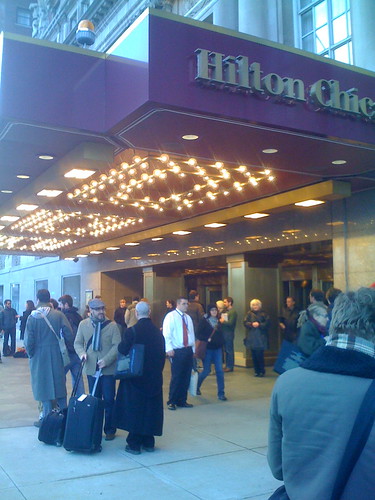
Writers gathering outside the Hilton (Smokers' walk)

Brian Bouldrey and University of Wisconsin Editor Raphael Kadushin
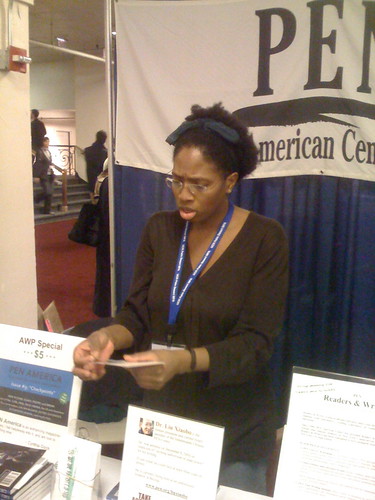
Stacy Leigh at the PEN American Center table

At the Bookfair
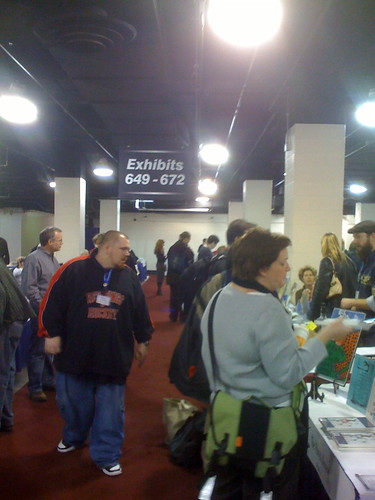
At the Bookfair
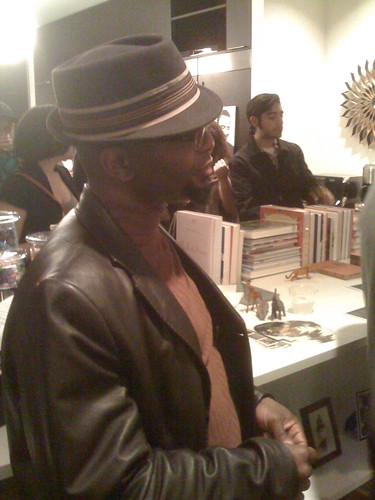
Tyehimba Jess at the Second Sun Salon
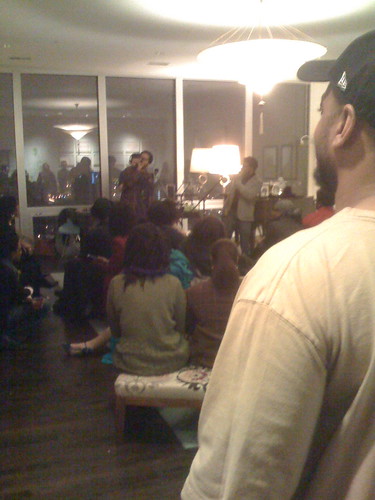
Avery Young and ensemble performing

Listening to the Salon performance (Christian Campbell at center)

Poet John Murillo performing at the Salon

Columbia College of Chicago window exhibit
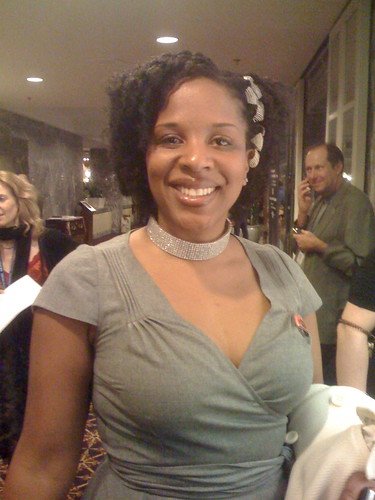
The brilliant and beautiful Tayari Jones
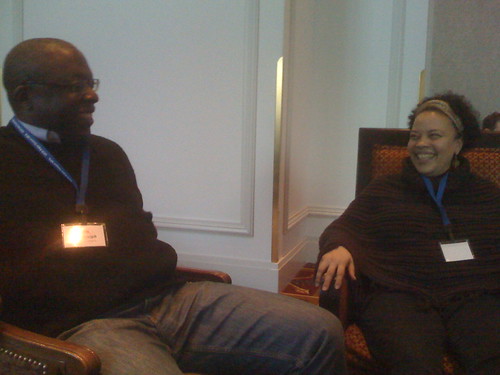
Ron Kavanaugh and Toni Asante Lightfoot (this was the first time I'd seen her since her new daughter was born!)
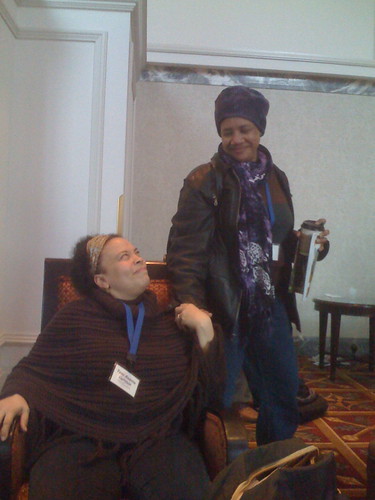
Toni and Kate Rushin
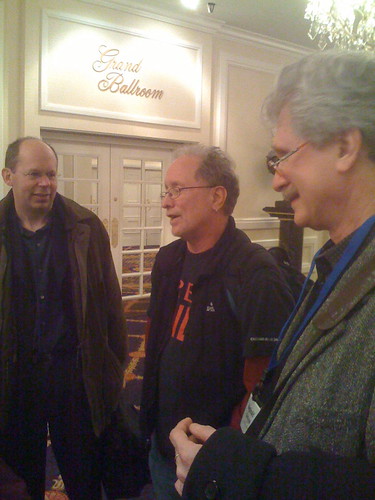
After my noon panel, (l-r) Alex Kotlowitz, Bill Ayers (yep, that's him!), and Reg Gibbons
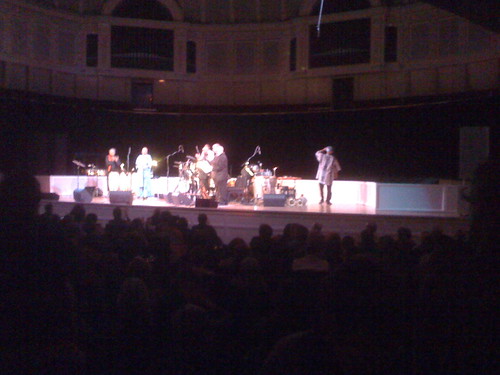
Max Roach's "We Insist! Freedom Now Suite" at Symphony Hall
I was on two panels on Thursday, the first a noon assembly called "The City--Real and Imagined," with my very famous university colleagues Reg Gibbons (the moderator), Sasha Hemon, Alex Kotlowitz, and Stuart Dybek, and that discussion drew a huge audience, including several of my graduate students (Jen I said hello to, but Anna, it was great to see you out there), and friends like wonderful poet Jaci Jones LaMon, who came up afterwards to say hello. I had the opportunity to expatiate, briefly, on Morrison, Ellison, Paley, and Proust, in one answer, which I must say doesn't come along very often. The second panel, later that afternoon, which I organized and moderated, focused on "Post-racial Writing," and brought together scholars Dorothy Wang and Angelica Lawson, and poet and critic Prageeta Sharma. All three offered provocative critiques of the notion of "post-raciality," and I only wish that we'd had more time to unpack the idea even more, particularly in light of my opening comments about perspective, performativities and normativities. The audience was one of the most racially and ethnically diverse I witnessed at the conference, and it was particularly great to see poet Samiya Bashir (!) sitting in the front row.
Thursday evening I participated in a full and packed reading at Myopic Books (one of the best used bookstores in Chicago, BTW) sponsored by Litmus Press/Aufgabe, Saturnalia Books, and Nightboat Books. Afterwards a poet archly asked me, "And what is your connection to these presses?" and I reminded him that some of my work--among the first published poems from Seismosis--appeared in Aufgabe. Other readers that night included Nathalie Stephens/Nathanaël, one of my favorite contemporary innovators, whose marvelous new book-length essay, Absence Where As, is out from Nightboat; Jennifer Scoppottone; Cal Bedient; Sebastian Agudelo; Lytton Smith, whose first book Terrance Hayes selected for Nightboat's most recent annual prize; and Laura Moriarty, whose work I've admired for years. Jennifer and another poet read from Italian translation section in the new Aufgabe (#7), and I urge you to pick it up if you're at all interested in new Italian poetry.
On Friday, after going to hear Maggie Brown's tribute to her late father, Oscar Brown Jr., and Deedee Bridgewater and an ensemble (including original sidemen Julian Priester and Ray Mantilla) bring the late Max Roach's "We Insist! Freedom Now Suite" to new heights (thank you again, Dorothy!), I dropped by the Second Sun Salon, hosted by Krista, Duriel and Lisa Lee at Lisa's dream space. I'm not going to be able to list all the folks I saw, but it was great to run into people from the Chicago poetry scene like Erin Teegarden, as well as so many people I hadn't seen in a while, including Denenge Akpem, Christian Campbell, Kelly Norman Ellis, Ross Gay, Tyehimba Jess, Parneshia Jones, Dawn Lundy Martin John Murillo, Obike, William Perdomo, Hermine Pinson, Evie Shockley, Treasure Williams, Ronaldo Wilson, Avery Young, and to meet folks I've only know via the Net, like Lillian Bertram and Doc Brown, or via their work, like David Mura. I caught the second half of the Salon performances, which featured John and Duriel performing their poems, and Avery performing Averyness! I only wish there'd been live feed so that everyone could have enjoyed them as much as the people at the event.
On Saturday I popped into a few panels, ran into a lot more people, including many university colleagues (Eula Biss, Shauna Seliy, Brian Bouldrey, Ed Roberson) and students (Barbara, Eric and others), whom I was so glad to see out and about, and spent a great deal of time at the Bookfair. So many books, so little time! I must give shout-outs to Essay Press and Canarium Books, founded by my colleagues Eula (and others) and Robyn Schiff (and others) respectively; Seismosis's publisher 1913 Press, and its founders poets Sandra and Ben Dollar (whose stock was snapped up, yea!); Northwestern University Press, and editor Parneshia Jones, who hipped me to some great new books they're publishing; and the PEN table, where my college friend Stacy Leigh was representing with grace and wit only she can! So far I've been able to read just one of the many books I bought, Monica de la Torre's incisive and often hilarious Public Domain (Segue Books, 2008), but I'm determined to scale the K-2 peaks of books I've been setting aside and viewing with waxing anticipation since the relentless academic year began.
And now, some photos (my ability to document via photographs appears to be diminishing at the same rate as my ability to blog or do anything else, save teach and read for work, but nevertheless):
Writers gathering outside the Hilton (Smokers' walk)
Brian Bouldrey and University of Wisconsin Editor Raphael Kadushin
Stacy Leigh at the PEN American Center table
At the Bookfair
At the Bookfair
Tyehimba Jess at the Second Sun Salon
Avery Young and ensemble performing
Listening to the Salon performance (Christian Campbell at center)
Poet John Murillo performing at the Salon
Columbia College of Chicago window exhibit
The brilliant and beautiful Tayari Jones
Ron Kavanaugh and Toni Asante Lightfoot (this was the first time I'd seen her since her new daughter was born!)
Toni and Kate Rushin
After my noon panel, (l-r) Alex Kotlowitz, Bill Ayers (yep, that's him!), and Reg Gibbons
Max Roach's "We Insist! Freedom Now Suite" at Symphony Hall
Langganan:
Postingan (Atom)